CB stands for Citizens Band. CB radio is a license-free, short-range radio service the FCC set aside for public use, with 40 shared channels between 26.965 and 27.405 MHz. Truckers, off-roaders, farmers and hobbyists still rely on it today because it works anywhere, with no cell signal and no monthly bill.
The name says a lot about the service. “Citizens” means it belongs to the public rather than to businesses, government agencies or licensed amateur operators. “Band” refers to the slice of radio spectrum it uses, which is why you will also hear it called the 11 meter band. Put together, Citizens Band is a stretch of the airwaves that any member of the public can use to talk, with no exam, no license and no subscription.
A Short History of Citizens Band Radio
The FCC created the 27 MHz Citizens Band service in 1958 with 23 channels. Back then, users needed a license. Few people bothered to get one.
CB took off in the 1970s. The 1973 oil crisis and the new national 55 mph speed limit sent truckers to their radios to find open fuel stations and warn each other about speed traps. Then the 1975 hit song “Convoy” and the movie Smokey and the Bandit made CB a household name. The FCC expanded the band to 40 channels in 1977, and it dropped individual licensing altogether in 1983.
The story continued well past the 1970s, and our full write-up on CB radio history and modern features covers it. The short version: CB never disappeared. It moved from a nationwide fad back to the tool it was built to be, dependable local communication for people on the move.
How CB Radio Works
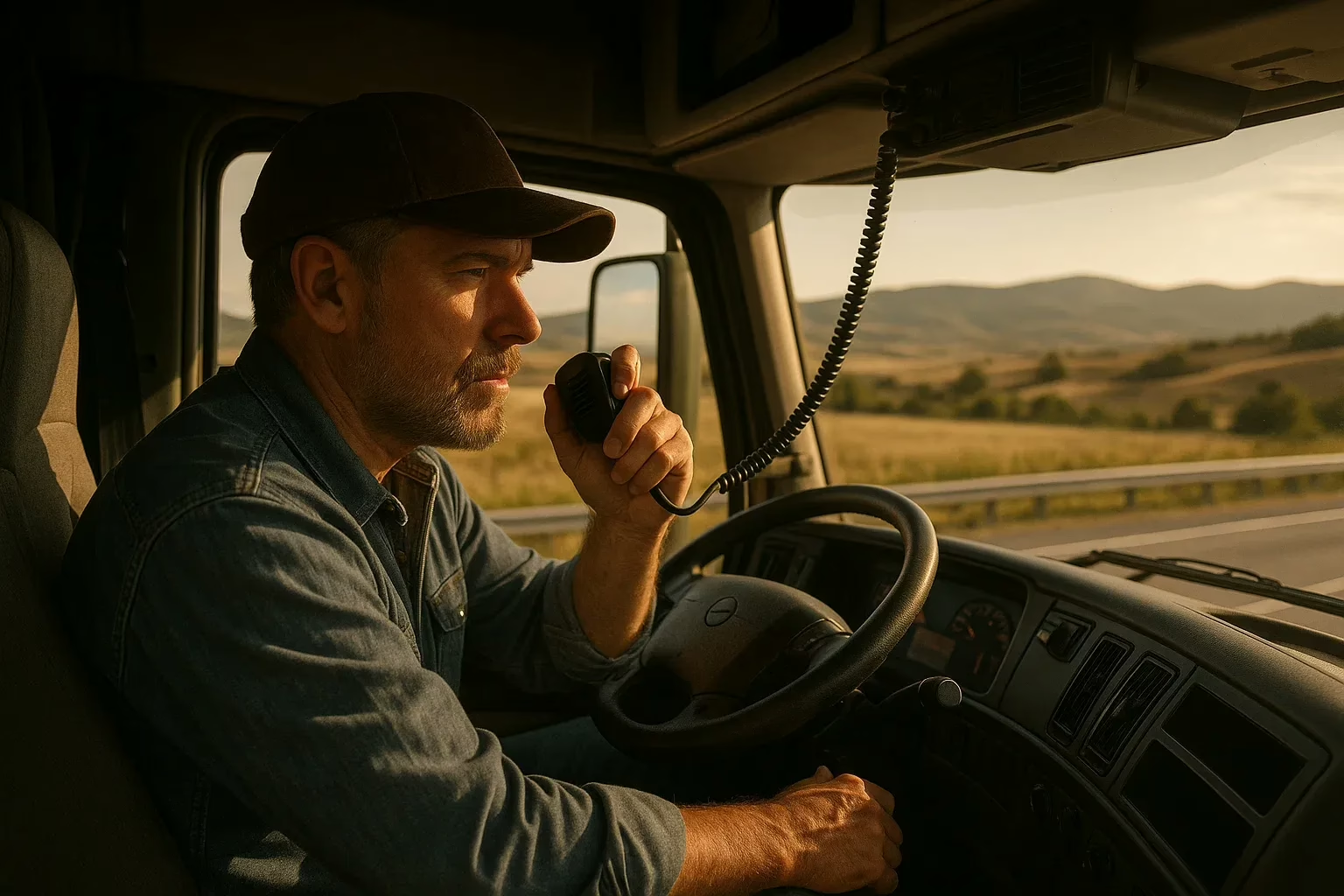
A CB radio is a two-way radio. Press the button on the microphone to talk and release it to listen. Every radio on the same channel within range hears you, so CB is an open, shared conversation rather than a private call.
Channels. There are 40 channels, each 10 kHz wide. Anyone can use any channel, but two have special roles:
- Channel 9 is reserved for emergency communications and traveler assistance.
- Channel 19 is the unofficial highway channel, where truckers swap traffic, weather and road reports.
Modes and power. The FCC’s CB rules under 47 CFR Part 95 set the limits. AM transmissions are capped at 4 watts. Single sideband (SSB) radios can transmit up to 12 watts peak envelope power, which is why SSB models reach farther and cut through noise better. Since a 2021 rule change, the FCC also allows FM on CB, so some newer radios offer AM, FM and SSB. Linear amplifiers and other power boosters are not legal.
Range. Most CB setups talk reliably from a few miles up to roughly 15 miles. The real range depends on terrain, weather, the radio’s mode, and above all the antenna. A well-placed, properly tuned antenna will do more for your range than a more expensive radio. Our CB antenna buying guide for truckers explains mounting and SWR tuning.
CB Radio Rules at a Glance
The FCC’s Citizens Band Radio Service page lays out the basics, which come down to a few points:
- No license is required. Anyone can operate a CB radio, with a few narrow exceptions such as foreign government representatives.
- Use FCC-certified equipment. Do not modify a radio to raise its power output.
- Emergency traffic comes first on every channel, at all times.
- Antenna height limits apply only to structure-mounted antennas. Vehicle-mounted antennas have no height limit.
If you are comparing CB to other services, our guide to whether you need a license for a two-way radio explains how CB fits alongside FRS, GMRS and licensed business radio.
Common CB Lingo You Will Hear
CB has its own shorthand, and much of it is still in use on Channel 19:
- 10-4: message received, or OK
- Breaker 1-9: a request to talk on Channel 19
- Handle: your on-air nickname
- Smokey: a police officer, especially state highway patrol
- What’s your 20?: where are you?
You do not need to know the lingo to use a CB, but it helps you follow what other drivers are saying.
Who Uses CB Radio Today
CB is still one of the most practical communication tools for people who spend their days on the road or off the grid.
- Truck drivers use it for live traffic, weather and road condition updates from drivers just ahead. Our list of the best CB radios for truckers covers the top picks.
- Off-roaders and overlanders use it to keep a convoy in touch on trails with no cell coverage.
- Farmers and rural crews use it between vehicles and equipment spread across large properties.
- Travelers and RV owners keep one in the vehicle as a backup when cell service drops.
CB Radio vs Business Two-Way Radio
CB is open to everyone, which is both its strength and its limit. Anyone in range can hear you, channels get crowded, and you cannot reserve a private channel. That works well for highway chatter. It works much less well for a business that needs clear, private, dependable dispatch.
Licensed business radios run on VHF or UHF frequencies assigned to your organization, and they can connect through repeaters or wide area networks to cover a whole region. For a side by side comparison, see CB radio vs two-way radio. For crews that need statewide or nationwide coverage without towers, LTE push-to-talk radios use cellular networks instead.
How to Choose a CB Radio
If you are shopping, start with how you will use it. A dash-mounted SSB radio suits long haul driving. A compact unit with all its controls in the handset suits a tight cab or a side by side. Weather alerts, noise cancelling and Bluetooth are worth paying for if you spend long hours behind the wheel. Our complete CB radio buying guide walks through every feature. For long haul drivers specifically, the CB radio guide for truckers goes deeper.
CB Radios and Installation From Whisler Communications
Whisler Communications has helped businesses, fleets and drivers across the Pacific Northwest stay connected since 1959. We carry CB radios and accessories, and we install and tune them so you get the range your setup is capable of. When your needs go beyond CB, we also design and support professional two-way radio systems, wide area networks and LTE push-to-talk solutions.
Not sure which radio fits your rig or your team? Contact us and we will help you pick the right setup.