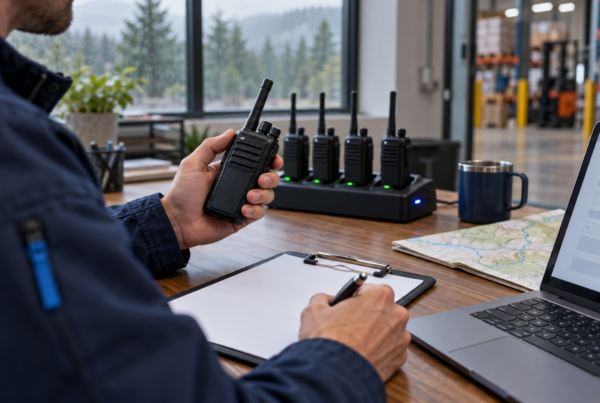

Security teams and private patrol officers depend on instant, reliable communication. Whether you are managing a multi-building campus, running perimeter checks across a parking structure, or coordinating a mobile patrol fleet, the radio on your hip is your lifeline. A dropped call or dead zone is not just an inconvenience in this line of work, it is a liability.
This guide breaks down the best two-way radios for security teams and private patrol in 2026, what features actually matter for the job, and how to match the right radio to your operational environment.
What Security Teams Actually Need in a Two-Way Radio
Not all two-way radios are built for security work. Consumer-grade radios may look similar on the shelf, but they fail quickly under the demands of daily patrol. Here is what sets a professional-grade security radio apart:
- Durability (IP and MIL-STD ratings): Radios used in security environments face rain, dust, drops, and extreme temperatures. Look for IP67 or higher water/dust resistance and MIL-STD-810 compliance.
- Battery life: A full 10- to 12-hour shift is standard. Officers cannot afford a dead radio at hour eight. Look for 2,000 mAh batteries or higher, ideally with multi-unit charging banks available.
- Audio clarity: Noise-cancelling microphones are essential in parking garages, near traffic, and in high-wind environments. Loud, clear audio on both transmit and receive prevents miscommunication.
- Emergency/Man-Down features: Lone-worker safety features like emergency alert buttons, man-down detection, and GPS tracking are increasingly standard in security deployments.
- Encryption: Security communications should never be monitored by unauthorized parties. Digital radios with voice encryption protect operational details and personnel safety.
- Talk range and coverage: Private patrol officers covering large sites or multiple properties need radios with strong coverage. PoC (Push-to-Talk over Cellular) radios extend range to essentially unlimited, where conventional UHF/VHF radios have a finite RF footprint.
- Ease of use with gloves: Large, well-spaced buttons and a tactile PTT are critical for officers wearing patrol gloves in cold or wet conditions.
Best Two-Way Radios for Security Teams: Top Picks for 2026
The following radios are recommended based on durability, feature set, and real-world performance in security and patrol applications.
Best Overall
Kenwood Viking VP8000 Multi-Band Portable Radio
The Viking VP8000 is one of the most versatile radios available for security professionals. Its multi-band capability means a single radio can operate across VHF, UHF, 700 MHz, and 800 MHz bands — a significant advantage for teams that work alongside public safety agencies or operate across jurisdictions with different frequency allocations.
Band CoverageVHF / UHF / 700 / 800 MHz
StandardP25 Phase 1 and 2, DMR
DurabilityMIL-STD-810 / IP67
DisplayColor, high-visibility
For private patrol contractors who serve clients with existing legacy systems or public safety contracts, the VP8000 eliminates the need to carry multiple radios. It supports both P25 Phase 1 and Phase 2 as well as DMR, making it future-ready as agencies migrate protocols.
Best for Daily Patrol
Kenwood Viking VP6000 Portable Radio
The Viking VP6000 hits the sweet spot for security teams that need a professional-grade radio without the multi-band complexity of the VP8000. It delivers clean digital audio, solid battery performance, and the same rugged build quality in a slightly leaner package.
BandUHF or VHF
ProtocolP25 Phase 1 and 2
DurabilityMIL-STD-810 / IP67
Use CaseSingle-band security deployments
Ideal for security teams operating within a single facility, campus, or district where one frequency band covers all operational needs. The VP6000 is cost-effective per unit, which matters when outfitting large patrol teams.
Best Budget-Friendly Professional
Kenwood Viking VP5000 Portable Radio
The Viking VP5000 is the entry point into the Viking professional lineup. It still meets MIL-STD and IP standards, making it far more durable than consumer alternatives. For guard companies or in-house security departments equipping a full team on a tighter budget, the VP5000 delivers reliable performance at a lower per-unit cost.
ProtocolP25 Phase 1
DurabilityMIL-STD-810 / IP54+
Best ForLarge team deployments
InteropP25 compatible systems
Best for Wide-Area and Mobile Patrol
Diga-Talk+ PoC Radios (LTE Push-to-Talk)
For private patrol operations that span large geographies — mobile patrols covering multiple client properties across a city, county-wide security contracts, or roving teams with no fixed base — conventional RF radios simply cannot provide the coverage needed. Diga-Talk+ Push-to-Talk over Cellular radios solve this by using existing LTE networks to deliver push-to-talk communication with effectively unlimited range.
CoverageNationwide LTE network
GPS TrackingBuilt-in, real-time
DispatchSoftware console available
Form FactorRadio-style handset
PoC radios are not a replacement for every security radio scenario. Inside buildings, parking structures, or areas with poor cellular coverage, conventional digital radios remain more reliable. Many professional security operations run a hybrid model: PoC radios for mobile patrol, conventional digital radios for fixed-site officers.
Conventional Radio vs. PoC: Which Is Right for Your Security Operation?
| Feature | Conventional Digital Radio | PoC / LTE Radio |
|---|---|---|
| Coverage area | Site-specific / regional repeater | Nationwide cellular footprint |
| Indoor penetration | Strong | Dependent on carrier signal |
| Monthly service cost | Low (no monthly fee after setup) | Data plan required per device |
| GPS / tracking | Optional add-on | Standard, real-time |
| Encrypted voice | Yes (digital protocols) | Yes (LTE encryption) |
| Dispatch software | Available with infrastructure | Included with platform |
| Best for | Fixed-site, campus, facility security | Mobile patrol, multi-property fleets |
Key Features to Prioritize for Private Patrol Radios
Lone-Worker and Man-Down Alerts
Officers working alone on patrol routes, overnight, or in remote areas of a large property need a radio that can call for help even when they cannot. Man-down detection uses the radio’s motion sensor to detect if an officer has been stationary at an unusual angle for a set period, then automatically broadcasts an emergency alert with GPS coordinates to dispatch or supervisors.
Voice Encryption
Security communications often include sensitive client information, descriptions of individuals being monitored, and patrol schedules. Any of these details in the hands of the wrong person creates a security vulnerability. Digital protocols like P25 and DMR both support voice encryption, and for any professional security deployment, it should be treated as a non-negotiable requirement rather than an optional feature.
Durability in All Weather
Private patrol officers work in rain, sleet, and summer heat. Radios should meet at minimum IP54 standards for water and dust resistance, with IP67 preferred for operations in wet or coastal environments. MIL-STD-810 certification confirms the radio has been tested against shock, vibration, humidity, temperature extremes, and altitude — exactly the conditions found in real patrol environments.
Long Battery Life with Multi-Unit Charging
A security shift typically runs 8 to 12 hours. Battery life should exceed that comfortably to account for high-use periods. For dispatch and operations centers managing a fleet, multi-unit charging banks keep every radio at full charge between shifts without requiring individual attention to each handset.
Pro Tip from Whisler Communications
One of the most common mistakes security directors make is buying radios without verifying repeater coverage at their specific site. Before committing to a radio system, Whisler Communications conducts a site survey to map signal coverage across every area your team will operate, including stairwells, parking structures, and basement levels.
Licensing and FCC Compliance for Security Radio Operations
Commercial security operations using two-way radios in the UHF and VHF bands are required to hold a valid FCC Part 90 license. Operating without a license on licensed frequencies is a federal violation and can result in substantial fines. The licensing process involves identifying the appropriate frequencies for your area and use case, which is where working with an authorized dealer is valuable.
Whisler Communications assists clients through the licensing process, helping identify available frequencies, prepare the FCC application, and ensure the radio system is programmed to comply with all regulatory requirements before going live.
Building a Complete Security Radio System
For most security teams, individual radios are just one piece of a larger communication system. A complete deployment typically includes:
- Repeater infrastructure: For sites larger than a few acres or with significant building structures, a repeater extends radio range and ensures consistent indoor coverage.
- Dispatch console: Supervisors and command staff benefit from a desktop or software dispatch console that provides visibility across all channels and units in the field.
- Accessories: Surveillance earpieces, remote speaker microphones, and drop-resistant cases all contribute to officer efficiency and radio longevity.
- Programming and configuration: Radios need to be correctly programmed with appropriate channel plans, tone codes, and group assignments before deployment. This is not a task to leave to guesswork.
Why Southwest Washington Security Teams Work with Whisler Communications
Whisler Communications has served businesses, municipalities, and public safety organizations in Southwest Washington since 1959. As an authorized dealer for Kenwood, Motorola, ICOM, and Diga-Talk+ PoC systems, the team at Whisler brings hands-on experience with radio system design, installation, and ongoing support.
For security companies and private patrol operations in the Olympia, Thurston County, and South Puget Sound region, we provide end-to-end service: from initial site survey and system design through radio programming, FCC licensing support, and long-term maintenance. When a radio system goes down, local support matters.
Ready to Equip Your Security Team?
Talk to a Whisler Communications specialist about the right radio system for your patrol operation. We serve security teams across Olympia, Thurston County, and Southwest Washington.