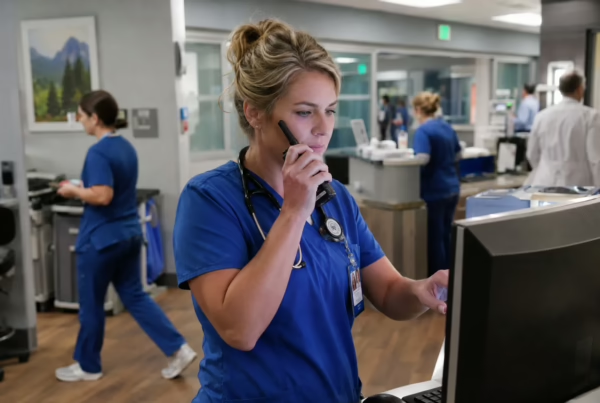
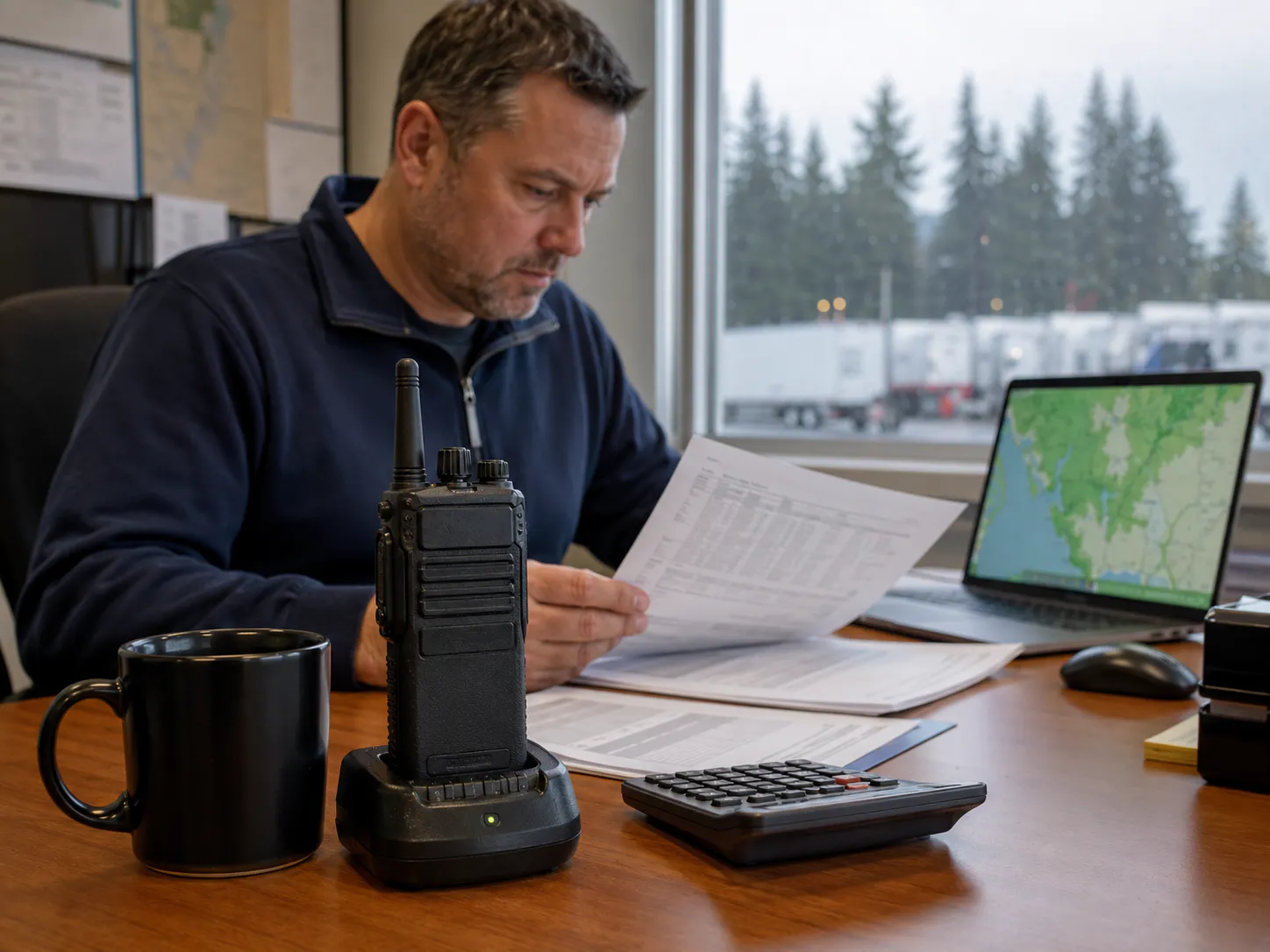
Two-way radio pricing used to be simple. You bought the radios, paid for an FCC license, maybe added a repeater, and you were done. LTE radios changed that math. Instead of one large upfront investment, you pay for hardware plus a monthly service plan, the same way you pay for a phone. That model is winning over fleets, schools, and field teams across Washington, but it raises the obvious question: what does it actually cost?
Here is the short answer. Most businesses pay between $150 and $600 per LTE handheld, plus a service plan that typically runs $15 to $30 per radio per month. A 10-radio team can usually get on the air for under $5,000 in year one, with no FCC license, no repeater, and no tower lease. The longer answer, including how that compares to a traditional radio system over five years, is below.
What You Are Actually Paying For
LTE two-way radios, also called PoC radios (Push to Talk over Cellular), send your voice over nationwide 4G LTE networks instead of a private radio frequency. Press the button, talk to your whole team, whether they are across the warehouse or across the state. If you want the full background on how the technology works, our post on why PoC is replacing traditional two-way radios covers it in detail.
From a budgeting standpoint, an LTE radio system has exactly two line items:
- Hardware: the radios themselves, plus any accessories
- Airtime: a monthly service plan per radio
That is the entire cost structure. Everything a traditional system requires you to build or license is already built into the cellular network you are riding on.
LTE Radio Hardware Costs
Handheld LTE radios generally run between $150 and $600 per unit. The spread comes down to build quality and features:
- Entry-level units sit at the lower end and suit indoor teams, retail floors, and light-duty use
- Professional rugged units with IP67 dust and water resistance, drop-rated housings, loud front-facing speakers, and long-shift batteries sit in the $350 to $600 range and are what we recommend for fleets, job sites, and outdoor crews
- Vehicle-mounted mobile units typically run $300 to $700 installed hardware, and pair naturally with handhelds on the same talk groups
Chargers are usually included. Budget a small amount extra for spare batteries, speaker microphones, and holsters, typically $30 to $100 per accessory. If you are outfitting vehicles, our two-way radio installation guide explains what a professional install involves and why it matters for audio quality and equipment lifespan.
What the Monthly Service Plan Costs
Most professional PoC service plans run $15 to $30 per radio per month, with volume pricing available on larger fleets. That subscription is doing a lot of work. A typical plan includes:
- Nationwide LTE airtime with automatic connection to the strongest available signal
- Unlimited push-to-talk on your private talk groups
- GPS location reporting on compatible devices
- Over-the-air updates and account management
Dispatch software, which lets an office coordinator see every radio on a map and manage talk groups from a PC, is sometimes bundled and sometimes licensed separately depending on the platform and plan. Contract terms also vary, from month-to-month flexibility to discounted annual agreements. When we quote a Diga-Talk+ system, we lay out the current plan options side by side so you can see exactly where each dollar goes.
What You Do Not Pay For
This is where LTE flips the traditional radio budget on its head. With an LTE system there is:
- No FCC license. Traditional business radio systems operate under an FCC Part 90 license, which involves an application, frequency coordination fees, and renewals, typically several hundred dollars every ten years. LTE radios ride on carrier networks that are already licensed, so this cost disappears entirely. Our post on whether you need a license for two-way radios breaks down the rules, and the FCC’s licensing pages have the official details.
- No repeater build. Extending traditional radio coverage across a large site or region means purchasing and installing repeater equipment, commonly $3,000 to $10,000 or more per site once installation is included.
- No tower or rooftop lease. Repeaters need high ground, and high ground charges rent, month after month, year after year.
- No infrastructure maintenance. The carrier maintains the network. You maintain nothing but the radios in your workers’ hands.
LTE vs Traditional Two-Way Radio: The Five Year Math
Here is an honest comparison for a 10-radio operation, using typical market pricing:
| Cost item | LTE (PoC) system | Traditional repeater system |
|---|---|---|
| Radios | 10 handhelds at $400 = $4,000 | 10 commercial portables at $900 = $9,000 |
| FCC license and coordination | $0 | Roughly $600 per 10-year term |
| Repeater and installation | $0 | Roughly $6,000 |
| Service plans | $25 x 10 radios x 60 months = $15,000 | $0 |
| Maintenance | Included | Roughly $500 per year = $2,500 |
| Five year total | About $19,000 | About $18,100 |
Notice something? Over five years the totals land surprisingly close. The real difference is not the bottom line. It is where the money goes and what you get for it.
The LTE system costs a fraction upfront, scales one radio at a time, covers your team anywhere there is cellular signal in the country, and includes GPS and modern features in the plan. The traditional system demands more capital on day one but has no monthly fees, and it keeps working even if cellular networks go down, which is why public safety agencies still build on land mobile radio.
Coverage is the deciding factor for many Washington operations. If your crews work in areas with reliable cellular coverage, LTE is hard to beat on flexibility. If they work beyond it, a wide area radio network or conventional system may serve you better. Whisler carries both, which means our recommendation is based on where your people actually work, not on what we happen to sell.
What Changes Your Price
A few factors move your quote up or down:
- Fleet size. Larger deployments earn better per-radio pricing on both hardware and airtime.
- Durability requirements. Warehouse and office teams can save with standard housings. Outdoor crews in Pacific Northwest weather should invest in IP67-rated units.
- GPS and dispatch needs. Live fleet mapping and a dispatch console add capability, and sometimes cost, depending on the plan.
- FirstNet capable devices. Teams that support public safety operations may want FirstNet Ready hardware for priority network access. FirstNet is the nationwide network built for first responders, and several Diga-Talk+ models are built for it.
- Vehicle installations. Professional mobile installs add labor but pay for themselves in reliability.
The Diga-Talk+ Lineup at Whisler Communications
Whisler Communications is a Diga-Talk+ dealer serving Olympia, Thurston County, and the greater Pacific Northwest. The lineup covers portable and vehicle-mounted options at different price points, including the Diga-Talk+ 9850 and Diga-Talk+ 9751 portables, the Diga-Talk+ 8051 and Diga-Talk+ 8900, and the FirstNet-ready Diga-Talk+ 8700 mobile. You can compare the full range on our LTE two-way radio service page.
How to Budget: A Worked Example
Say you run a 10-person field service team across Thurston and Pierce counties. A realistic first-year budget looks like this: 10 rugged LTE handhelds at roughly $400 each is $4,000, service plans at roughly $25 per radio per month add $3,000 for the year, and a handful of spare batteries and speaker mics round it to about $7,500. Year two onward, your only recurring cost is the $3,000 in airtime. No license renewals, no repeater servicing, no surprises.
Compare that to the $15,000 or more a repeater-based system needs before the first transmission, and it is easy to see why so many growing businesses start with LTE and expand from there.
Get Exact Pricing for Your Team
Typical market ranges only get you so far. Your actual quote depends on fleet size, coverage area, features, and plan term, and those numbers change as carrier promotions and hardware pricing move. Whisler Communications has been matching Pacific Northwest teams with the right communication systems since 1959, and because we sell both LTE and traditional radio systems, you will get the option that genuinely fits your operation.
Contact us or call (360) 352 8777 for a line-item quote on a Diga-Talk+ system for your team.
Frequently Asked Questions
Do LTE two-way radios require an FCC license?
No. LTE radios operate on licensed carrier networks, so there is no FCC application, frequency coordination, or renewal fee for your business.
Do LTE radios work where there is no cell coverage?
They need an LTE or Wi-Fi connection to communicate. Coverage across Washington’s populated areas and major corridors is strong, but crews working deep in remote terrain may be better served by a conventional or wide area radio system. We can map your routes against current coverage before you buy.
Can LTE radios talk to our existing two-way radios?
In many cases, yes. Interoperability gateways can bridge PoC talk groups with existing radio systems, which lets you transition in phases instead of replacing everything at once. Ask us about your specific equipment.
Is there a contract?
Plan terms vary by provider and promotion, from flexible monthly plans to discounted annual agreements. We will walk you through the current Diga-Talk+ options when you call.