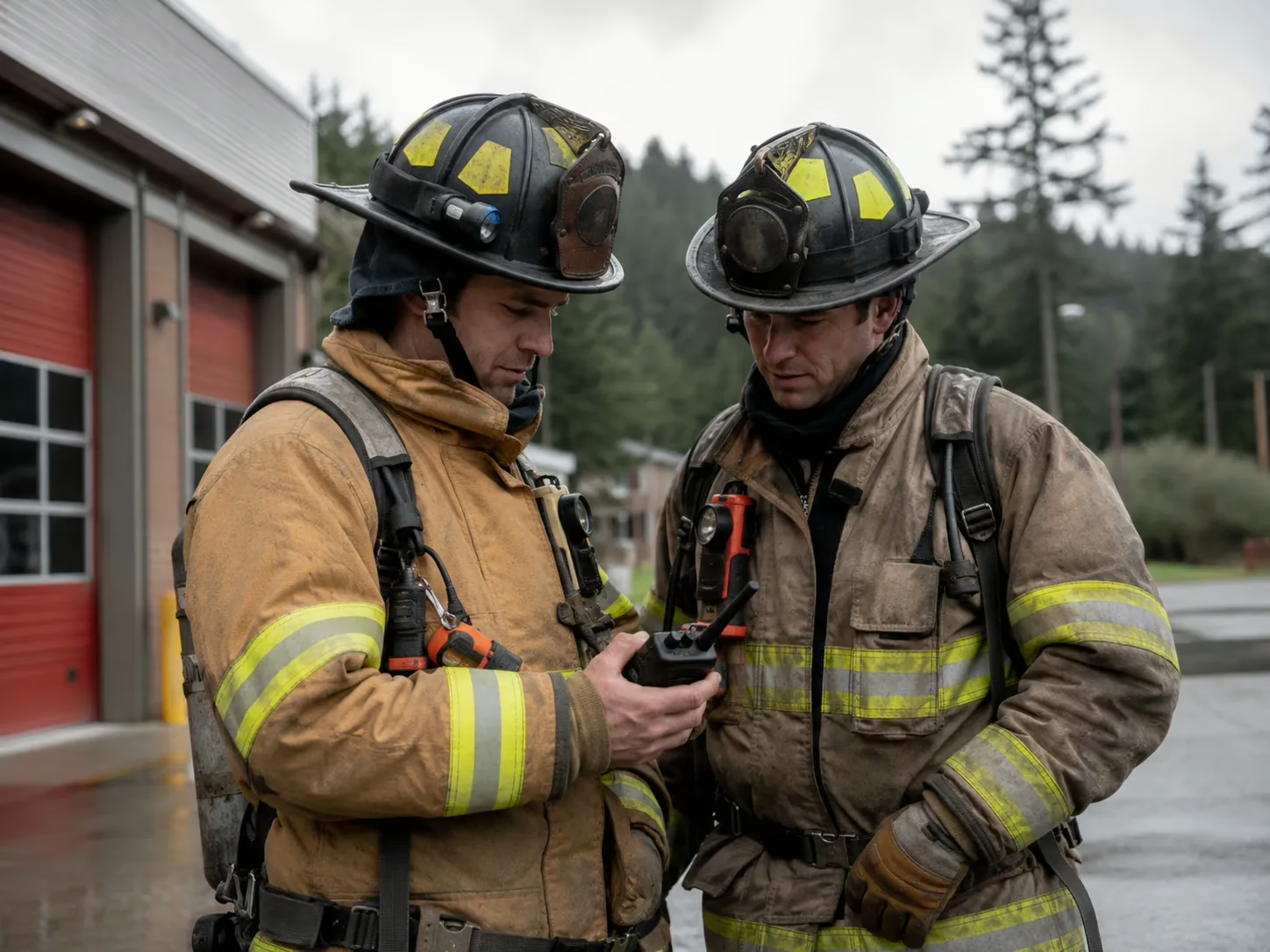
When fire departments across Washington State talk about radio interoperability, they are talking about P25. It is the communication standard that allows a Lewis County volunteer crew to talk to a DNR helicopter, a Pierce County career department to coordinate with Thurston County EMS, and multiple agencies to work a mutual aid incident without carrying a different radio for each system.
For fire departments evaluating radio equipment, P25 compatibility is not a feature to consider alongside other features. It is a baseline requirement for any department that participates in mutual aid, connects to a county or regional radio network, or works alongside other public safety agencies. This post explains what P25 is, why it matters specifically for Washington fire departments, and which radios meet the standard.
What P25 Actually Means
Project 25, commonly called P25 or APCO-25, is a suite of standards developed jointly by the Association of Public Safety Communications Officials and the telecommunications industry. It defines how digital radio systems and devices communicate, ensuring that equipment from different manufacturers can work together on the same network.
Before P25, public safety agencies frequently ended up with incompatible systems, a problem that became national news after the September 11 attacks when first responders from different agencies could not communicate with each other on scene. P25 was developed as the solution: an open standard that any manufacturer can build to, ensuring that a radio from one vendor can talk to a radio from another vendor on a compliant network.
In practical terms for a Washington fire department, P25 compliance means:
- Your radios can connect to county and regional trunked networks
- Mutual aid agencies arriving on scene can communicate with your crew directly
- Your department can connect to FleetNet and other wide area networks serving the Pacific Northwest
- Federal agencies including DNR, US Forest Service, and other wildland fire resources can interoperate with your system during major incidents
- Your equipment investment is protected as networks upgrade over time
P25 in Washington State
Washington has invested significantly in P25 infrastructure at both the county and regional level. The Puget Sound Emergency Radio Network (PSERN) completed its transition to P25 Phase 2 in 2023 and now serves as the daily backbone for fire departments, law enforcement, and EMS across King County, supporting over 18,000 radios across more than 60 transmission sites.
Outside King County, county and regional networks across Southwest Washington, including the areas Whisler Communications serves in Thurston, Pierce, Mason, Lewis, Grays Harbor, Kitsap, and Clark counties, use P25 compatible infrastructure for public safety communications. FleetNet, the wide area trunked network that provides coverage across Washington, Oregon, and several neighboring states, operates on P25 compatible architecture and is a key resource for departments needing wide area coverage beyond their local system.
For volunteer and combination departments in rural Southwest Washington, connecting to P25 infrastructure through FleetNet is often the most practical path to professional-grade wide area coverage without building private tower infrastructure. Our post on two-way radio systems for volunteer fire departments covers how that works in practice.
P25 Phase 1 vs Phase 2: What the Difference Means for Your Department
P25 has two phases and the difference matters when selecting equipment.
P25 Phase 1 uses FDMA (Frequency Division Multiple Access) technology. It is the original P25 standard and remains widely deployed. Radios that support Phase 1 can connect to most existing P25 networks in Washington State.
P25 Phase 2 uses TDMA (Time Division Multiple Access) technology, which doubles the channel capacity of the same spectrum. Newer regional networks including PSERN operate on Phase 2. Radios that support only Phase 1 can still operate on Phase 2 networks in conventional mode, but cannot take full advantage of Phase 2 trunking efficiency.
For departments purchasing new radios today, choosing P25 Phase 2 compatible equipment is the right long-term decision. Networks across Washington are progressively upgrading and a radio purchased now should be able to take full advantage of Phase 2 infrastructure as it expands.
NFPA 1802: The Fire-Specific Radio Standard
Beyond P25, fire departments should be aware of NFPA 1802, the Standard on Portable RF Voice Communications Equipment for Use by Emergency Services Personnel at the Incident Scene. This standard, published by the National Fire Protection Association, establishes specific durability, thermal protection, and performance requirements for radios used in structural firefighting environments.
A radio that meets P25 compliance but not NFPA 1802 may not be rated for interior structural firefighting conditions. For departments equipping crews who perform interior attacks, NFPA 1802 compliance is an important specification to confirm alongside P25. Not all P25 radios are NFPA 1802 rated, and the two standards address different aspects of fitness for fire service use.
P25 Compatible Radios for Washington Fire Departments
Whisler Communications carries P25 compatible radios from several manufacturers. The options we most commonly recommend for fire departments in Southwest Washington are from the Kenwood Viking series, which provides full P25 Phase 1 and Phase 2 support alongside multi-protocol operation.
Kenwood Viking VP5000
The VP5000 supports P25 Phase 1 and 2, NXDN, DMR, and analog FM in a compact form factor. It includes GPS, man-down detection, lone worker mode, and emergency alert capability. At under 5.5 inches tall it is a strong choice for departments that need a capable, full-featured P25 radio in a size that works for structural firefighting. Suitable for smaller departments and those equipping line personnel where form factor and simplicity of operation matter.
Kenwood Viking VP6000
The VP6000 builds on the VP5000 with enhanced audio output designed for high-noise environments, improved battery performance for extended operations, and a form factor optimised for wear during long shifts. The audio improvement is relevant for fire service use where ambient noise from equipment, ventilation, and SCBA makes radio clarity more challenging. A strong choice for departments equipping crews for extended operations including wildland fire assignments.
Kenwood Viking VP8000
The VP8000 is the most capable option for departments that need full multi-band, multi-protocol operation. It operates across VHF, UHF, and 700/800 MHz bands simultaneously, supports P25 Phase 1 and 2, NXDN, DMR, and analog FM, and includes GPS, Bluetooth, Wi-Fi, and advanced encryption. For departments that work across multiple counties, connect to both local and regional networks, or participate in complex mutual aid deployments requiring communication across several agency radio systems, the VP8000 handles all of it in a single device. For a detailed comparison of the VP6000 and VP8000, see our post on why departments upgrade to the VP8000 multi-band radio.
Motorola Solutions
Whisler Communications also carries Motorola P25 compatible radios for departments that have an existing Motorola fleet or a preference for Motorola equipment. The APX series provides P25 Phase 1 and 2 support with the durability and fire service features that Motorola’s public safety lineup is known for. Contact us to discuss Motorola options alongside the Kenwood Viking lineup.
What to Consider When Selecting P25 Radios for Your Department
Current network infrastructure. What network does your county or region operate? If you are connecting to a Phase 2 trunked network, your radios need Phase 2 support to use it fully. Whisler can confirm the network requirements for your county before you purchase.
Interoperability requirements. Which agencies does your department regularly work with on mutual aid? Understanding their radio systems helps determine whether you need multi-band capability or specific protocol support beyond standard P25.
NFPA 1802. If your department performs interior structural attacks, confirm NFPA 1802 compliance for any radio being issued to interior crews.
Safety features. Man-down detection, lone worker mode, GPS tracking, and emergency alert are now standard expectations for fire service radio equipment. Confirm these are included in any radio under consideration. Our post on top radio features every fire department needs covers these in detail.
Grant funding. P25 radio equipment is eligible for AFG grant funding. If your department is planning a radio upgrade, the AFG grant program provides a funding pathway worth exploring before committing to a purchase. Whisler Communications assists departments with the equipment planning and quote preparation that supports a strong AFG application.
Long-term support. A P25 radio is a multi-year investment. Choosing a provider who can handle programming, FCC licensing, maintenance, and system updates locally matters over the life of the equipment. Whisler Communications provides full ongoing support for the radio systems we install across Southwest Washington.
Working with Whisler Communications
Whisler Communications has supported fire departments and public safety agencies across Southwest Washington since 1959. We understand the P25 networks operating in this region, the mutual aid relationships between local departments, and the practical requirements of fire service radio selection from portable equipment to mobile radios, base stations, and repeater infrastructure.
If your department is evaluating P25 equipment, planning a radio upgrade, or preparing for an AFG application, we can help with system assessment, equipment recommendations, FCC licensing, and professional installation across Thurston, Pierce, Mason, Lewis, Grays Harbor, Kitsap, and Clark counties.
Contact Whisler Communications to discuss P25 radio options for your department.