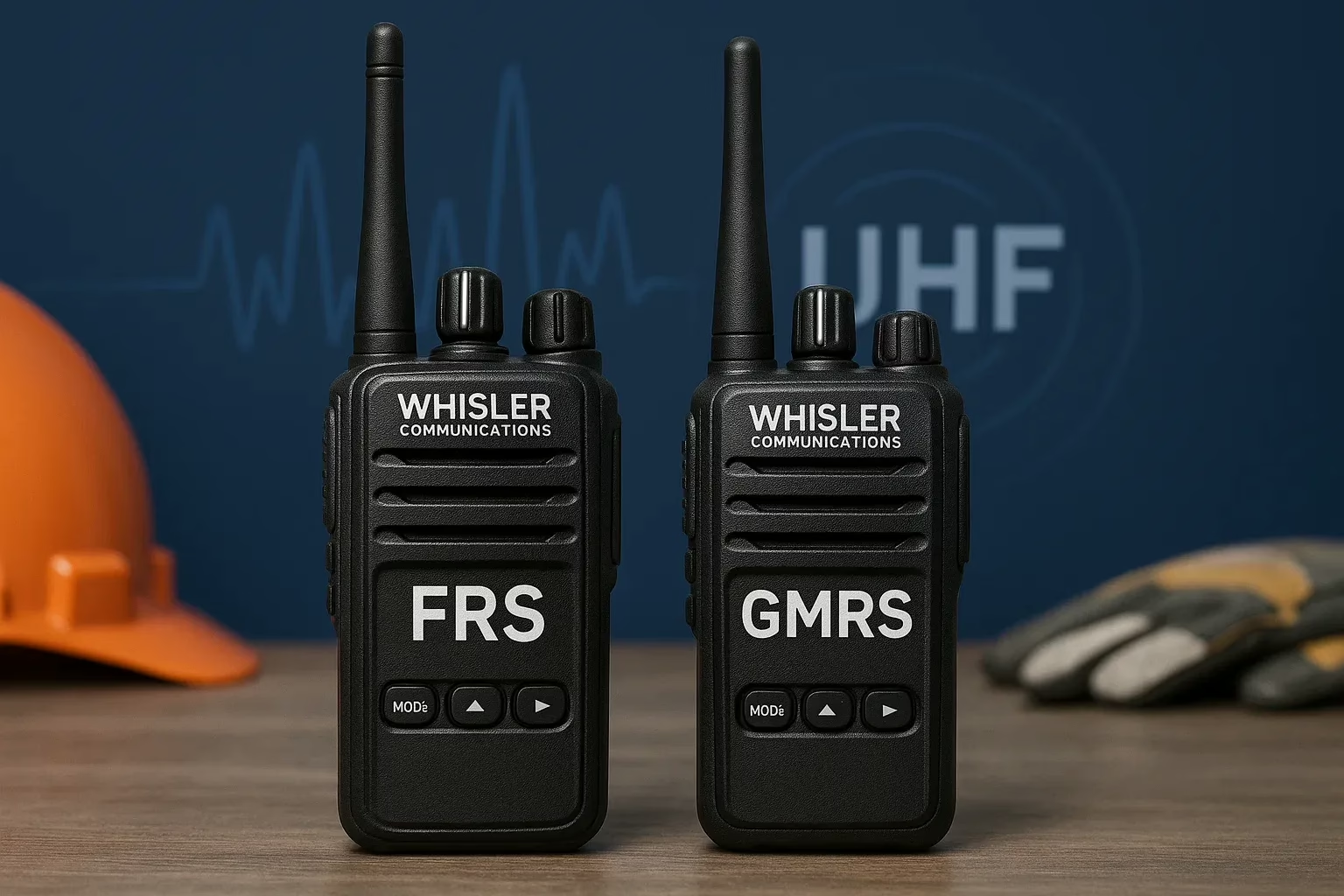
FRS and GMRS are two of the most searched radio services among businesses looking for a simple, affordable communication option. Both operate on UHF frequencies, both are regulated by the FCC, and both are available as consumer-grade handheld radios. But they are designed for very different levels of performance, and choosing the wrong one creates real operational problems, either illegal operation or a system that cannot cover the ground your team needs to cover.
This post explains what FRS and GMRS actually are, where the key differences lie, and how to decide which service fits your operation. It also covers the question most business owners have but rarely find a direct answer to: can businesses legally use FRS and GMRS radios for commercial operations?
What FRS Is
Family Radio Service (FRS) is a personal radio service regulated by the FCC under Part 95. It operates on 22 channels between 462 and 467 MHz. FRS radios are limited to 2 watts on most channels and 0.5 watts on channels 8 through 14. Antennas must be fixed and non-removable.
No license is required to use FRS. Anyone can buy an FRS radio and start using it immediately, which is why FRS radios are widely sold as consumer walkie-talkies in retail stores.
The practical range of an FRS radio in a typical commercial environment is 0.5 to 2 miles in open conditions, significantly less inside buildings, in urban areas, or in terrain with hills and tree cover. FRS radios cannot connect to repeaters, which means range is limited to direct radio-to-radio line of sight.
FRS is appropriate for:
- Small retail operations coordinating within a single store
- Hospitality teams working within a single building or property
- Light event coordination over short distances
- Any operation where the team stays within roughly half a mile of each other
What GMRS Is
General Mobile Radio Service (GMRS) operates on the same 22 channels as FRS plus additional GMRS-only channels. GMRS allows up to 50 watts of transmit power on fixed stations and higher power on mobile units compared to FRS, which significantly extends range. GMRS also supports repeater operation, which allows users to extend communication range well beyond handheld-to-handheld distance.
GMRS requires an FCC license. The license is a Part 95 individual license that costs $35, is valid for 10 years, and covers the licensee and their immediate family. No examination is required. For business use, all employees operating on GMRS frequencies need to be covered under a valid license, which means the business entity itself needs its own license rather than relying on an individual’s personal license.
GMRS is appropriate for:
- Operations that need more range than FRS can provide
- Teams working across large properties, farms, or outdoor areas
- Users who want to add a repeater to extend coverage
- Off-road groups and field crews operating in challenging terrain
The Key Differences Side by Side
| Feature | FRS | GMRS |
|---|---|---|
| License required | No | Yes ($35, 10 years) |
| Max power | 2 watts | Up to 50 watts (fixed) |
| Repeater capability | No | Yes |
| Antenna | Fixed, non-removable | Removable, upgradeable |
| Channels | 22 shared | 22 shared plus GMRS-only |
| Typical range | 0.5 to 2 miles | 5 to 25 miles with repeater |
| FCC Part | Part 95 | Part 95 |
| Business use | Permitted | Permitted with license |
Can Businesses Use FRS and GMRS Legally?
Yes, with important qualifications.
FRS is permitted for business use under FCC rules. However, because FRS radios share 22 channels with millions of other consumer users, there is no privacy or exclusivity. Anyone with an FRS radio can listen to and transmit on the same channels. For operations where communication privacy matters, coordination security is needed, or where channel congestion is likely, FRS is not the right tool.
GMRS is also permitted for business use, but the business needs its own FCC license. A personal GMRS license covering an individual and their family does not extend to commercial employees. For a business deploying GMRS radios, the correct approach is obtaining a GMRS license in the business name that covers all employees using the system.
The more important limitation for both services is that neither FRS nor GMRS is designed for large-scale commercial operations. For businesses that need private channels, higher power, encryption, or connection to a wide area network, a licensed commercial two-way radio system under FCC Part 90 is the appropriate solution. Our post on FCC regulations for two-way radio covers the full licensing landscape for commercial operations.
FRS vs GMRS vs Licensed Commercial Radio: Which Does Your Business Need
Choose FRS if your team works within a single building or small property, you need the simplest possible setup with no licensing overhead, communication privacy is not a concern, and your team stays within about half a mile of each other at all times. Typical users include small retail stores, food service operations, and light event coordination within a single venue.
Choose GMRS if your team works across larger properties or outdoor areas, you want more range than FRS provides, you are willing to obtain an FCC license, and you may want to add a repeater in the future to extend coverage further. Typical users include farms, large outdoor properties, off-road groups, and small field operations.
Choose a licensed commercial system if your team needs private, secure channels, you are operating in an industry that requires Part 90 compliance (construction, healthcare, public safety adjacent), you need to connect to a wide area network or repeater infrastructure, your team covers multiple sites or large geographic areas, or encryption is a requirement. This is the appropriate solution for most professional business deployments. See our guide to choosing the right two-way radio for your business for a full breakdown of commercial system options.
Interoperability Between FRS and GMRS
FRS and GMRS radios can communicate on the 22 shared channels. An FRS radio and a GMRS radio set to the same shared channel can talk to each other. However, FRS radios cannot access GMRS-only channels or use GMRS repeaters. In a mixed group where some members have FRS radios and others have GMRS radios, everyone must operate on shared channels for consistent communication.
For teams where some members work close to base and others work in the field at greater distances, a GMRS system with a repeater allows the field team to connect back through the repeater while the base team uses standard handheld range. FRS members in that group would only be able to reach the repeater if they are within direct handheld range of it.
MURS: A Third Option Worth Knowing
If your operation needs simple, license-free radio communication but wants to avoid the congestion of FRS channels, MURS (Multi-Use Radio Service) is worth considering. MURS operates on five VHF channels and does not require a license for personal or business use. It is less congested than FRS because VHF radios are less commonly used as consumer walkie-talkies. MURS does not support repeaters and is limited to 2 watts, so range is similar to FRS, but the VHF frequencies provide better range in open outdoor environments. Our post on FCC regulations for two-way radios covers MURS alongside FRS, GMRS, and Part 90 commercial licensing.
Getting the Right Solution for Your Operation
If you are not sure whether FRS, GMRS, or a licensed commercial system is right for your team, the answer usually comes down to three questions: how far does your team need to communicate, does your operation require private or secure channels, and are you willing to obtain an FCC license for better performance?
Whisler Communications helps businesses across Southwest Washington work through these questions and choose the right radio service and equipment for their specific environment. We carry Kenwood, Icom, Motorola, and Diga-Talk+ LTE radios for operations that need professional-grade performance beyond what FRS and GMRS can provide.
Contact Whisler Communications to discuss the right radio service and equipment for your team.