In the field, seconds matter. Whether coordinating a response to an active incident, managing a multi-agency search and rescue operation, or staying connected during routine patrol across rural terrain, law enforcement needs a communication system that is fast, secure, and available everywhere officers operate.
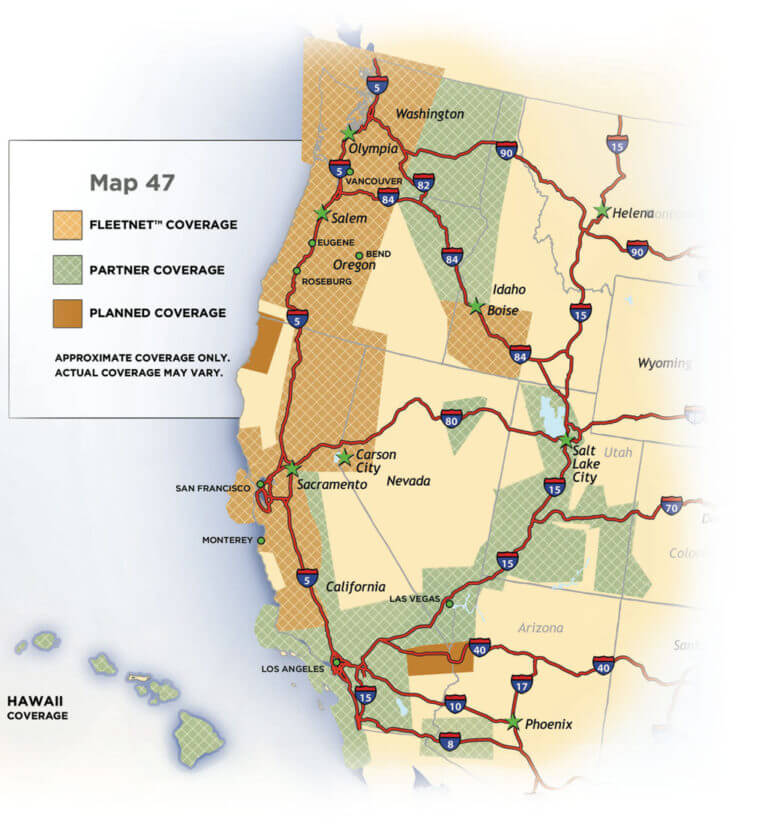
FleetNet is the nation’s largest privately owned digital trunked radio network, purpose-built for organisations that cannot afford communication failure. It is already the backbone of public safety communications for police, sheriff, and emergency response agencies across Washington, Oregon, Idaho, Nevada, and California.
This post covers how law enforcement agencies use FleetNet in practice, what makes it suited to public safety specifically, and how departments in Washington State connect to the network through Whisler Communications.
What FleetNet Is and How It Works
FleetNet is a wide area digital trunked radio network that operates across a series of high-power mountaintop RF sites, providing seamless coverage across large geographic areas without departments needing to build or maintain their own tower infrastructure.
Trunked radio systems work differently from conventional radio. Rather than assigning a fixed frequency to each user or group, a trunked system dynamically allocates available channels across the network as calls are made, which means more efficient use of spectrum, less congestion, and instant access even when the network is busy. For law enforcement with multiple units, dispatch channels, and interagency talk groups all active simultaneously, trunking is the practical standard for serious public safety communications.
FleetNet’s infrastructure is already built and operational. Agencies connect their radios to the network rather than funding tower construction, frequency licensing, and ongoing infrastructure maintenance themselves. This makes professional-grade wide area coverage accessible to departments of any size, from a small-town police department to a large county sheriff’s office.
Proven Performance Across the U.S.
Why FleetNet Works for Law Enforcement Specifically
Instant Push-to-Talk with No Lag
Officers depend on immediate communication. FleetNet’s digital trunked architecture delivers instant push-to-talk with no perceptible delay, connecting officers to dispatch, to each other, or to command in real time. This is not a minor operational detail. In active incident response, a two-second delay in radio communication is a meaningful operational problem. FleetNet eliminates it.
AES Encryption as Standard
Unencrypted analog radio communications can be monitored with a consumer scanner. This is a genuine security vulnerability for law enforcement, particularly during sensitive operations, suspect tracking, or situations where tactical information would compromise officer safety if intercepted.
FleetNet uses AES (Advanced Encryption Standard) encryption across communications, the same standard used by federal agencies for classified communication. Transmissions are protected from scanner intercept and unauthorised listeners as a baseline, not an add-on. For departments that handle sensitive investigations or work alongside federal agencies with strict communication security requirements, this is a non-negotiable capability.
Multi-County and Cross-Jurisdictional Coverage
Many law enforcement situations do not respect county lines. Pursuits cross jurisdictions. Mutual aid agreements require agencies to communicate across borders. Search and rescue operations span large geographic areas. Detectives work cases that move between cities and counties.
FleetNet’s coverage footprint across Washington State supports seamless communication as officers move between jurisdictions without re-programming radios or switching systems. Departments operating under mutual aid agreements can be configured to share talk groups across the network, making cross-agency coordination practical rather than cumbersome.
For agencies in Southwest Washington specifically, the combination of FleetNet coverage and the regional wide area network infrastructure Whisler Communications supports provides consistent connectivity from urban Thurston County corridors into rural Lewis, Mason, and Grays Harbor county terrain where conventional radio coverage is limited.
Priority Channel Access During Major Incidents
During large-scale incidents, radio networks experience increased load as more agencies and units come online. FleetNet’s trunked architecture manages this through dynamic channel allocation, but priority access settings ensure that command and critical safety communications are not displaced by routine traffic during high-load situations.
This matters during events like natural disasters, active shooter response, or large-scale mutual aid deployments where multiple agencies are simultaneously on the network.
Emergency Alerts and Location Tracking
FleetNet-compatible radios support one-button emergency alerts that immediately notify dispatch and command with the officer’s identity and location. Combined with GPS-enabled radios, this gives command centres real-time visibility of officer positions during active incidents, improving both situational awareness and officer safety.
For departments considering officer safety features in more depth, our post on two-way radios for workplace safety covers man-down detection, lone worker mode, and emergency alert features available on compatible hardware.
Scalability Without Infrastructure Investment
A small department connecting to FleetNet gets access to the same network infrastructure as a large state agency, without building or funding any of it. As a department grows, adds units, expands its patrol area, or takes on new mutual aid responsibilities, FleetNet scales with it through radio additions and talk group configuration rather than infrastructure projects.
This is the core advantage over building a private radio system. Private systems require ongoing capital investment in towers, repeaters, frequency licensing, and maintenance. FleetNet converts that into a predictable operational cost with professional network management handled externally.
Compatible Radios for FleetNet
Not all radios connect to FleetNet. The network requires P25-compatible digital radios that support trunked operation. For law enforcement agencies in Washington State, the radios Whisler Communications most commonly deploys on FleetNet are from the Kenwood Viking series.
The Viking VP8000 multi-band portable is the most capable option, supporting VHF, UHF, and 700/800 MHz operation alongside P25 Phase 1 and 2, NXDN, DMR, and analog FM. For agencies that need to connect to FleetNet while also maintaining interoperability with other regional systems, the VP8000 handles it in a single device.
The Viking VP6000 and VP5000 are also FleetNet-compatible and provide strong options for departments that want P25 trunking capability in a more compact form factor. For a full breakdown of the Viking lineup and how the models compare, see our Kenwood radio buyer’s guide.
FleetNet for Washington State Law Enforcement
Whisler Communications has supported public safety radio systems across Southwest Washington since 1959. We handle FleetNet network connections, radio programming, P25 system configuration, and ongoing support for law enforcement and public safety agencies in Thurston, Pierce, Mason, Lewis, Grays Harbor, Kitsap, and Clark counties.
If your department is evaluating FleetNet as a replacement for an aging radio system or looking to extend coverage across a wider area, we can assess your current setup and map out a practical transition path. For agencies considering whether the investment makes sense, our post on signs it is time to upgrade your radio system covers the operational indicators that typically drive that decision.
Contact Whisler Communications to discuss FleetNet connectivity for your department.